Veo Gives You the Stats. PlayTicks Gives You the Context.
Veo provides the stats, but coaches provide the context. PlayTicks helps capture key moments and turn game footage into meaningful coaching and player development opportunities.
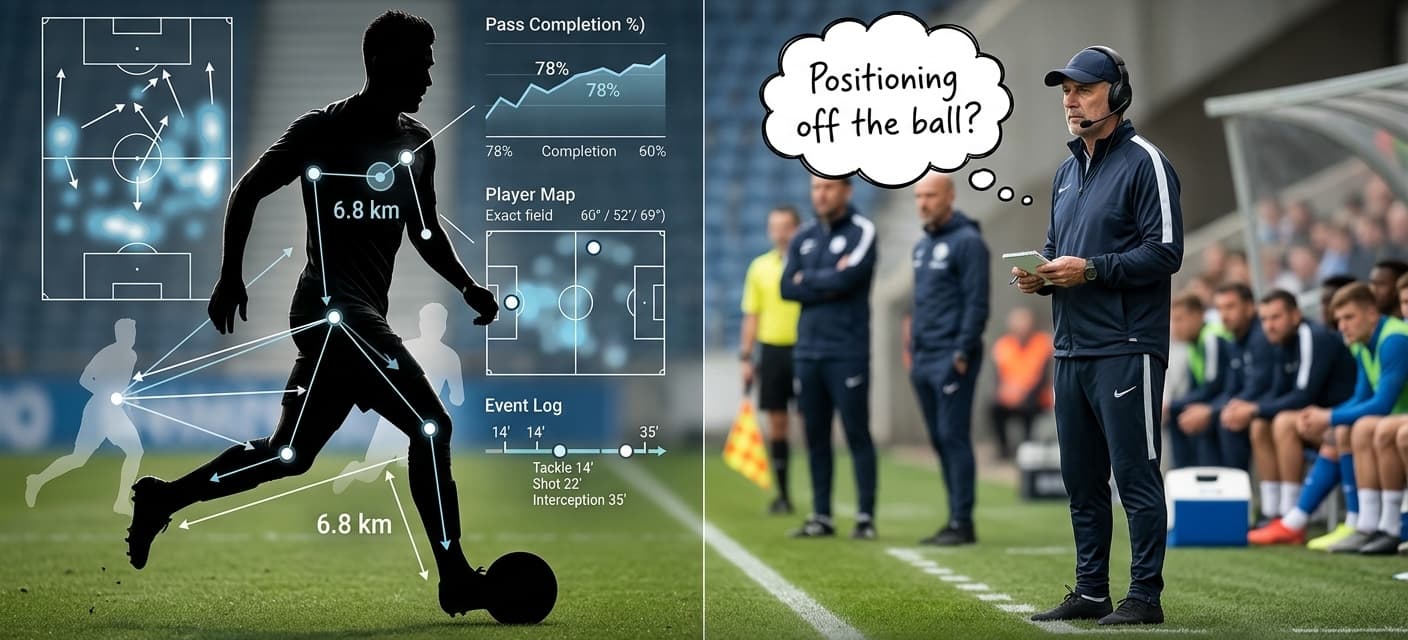
Modern soccer technology can tell us more about a match than ever before — goals, shots, possession, passes, player movement, distance covered. Platforms like Veo can turn raw footage into heat maps, passing networks, and detailed statistics that help coaches understand what happened during a game.
But there's a question that statistics alone can't answer:
What did it mean?
That's where the coach comes in. And that's where PlayTicks fits.
The Gap Between Data and Meaning
Consider a 0–0 match between Arsenal and Ipswich Town.
The data shows Bukayo Saka had seven shots but didn't score. Seven shots sounds significant. But what if three of those came when a teammate was in a better position to finish?
The statistic says: Saka had seven shots.
The coach sees: Saka had three opportunities to play someone through instead of shooting.
Those are two completely different pieces of information.
Now flip to Ipswich. Julio Enciso had only two shots. Defender Issa Diop made five successful tackles. On paper, Ipswich's attacking output looks underwhelming. But if the game plan was to defend compactly, frustrate Arsenal, and stay dangerous on the counter — those same numbers tell a different story entirely.
Ipswich kept a clean sheet.
The numbers didn't change. The context did.
Data Is Evidence. Context Creates the Story.
Match statistics are genuinely valuable. They help coaches find patterns and ask better questions:
- Why did we create so few chances?
- Where were our shots coming from?
- Where did we keep losing possession?
- Which players were involved in key moments?
But data has limits. It doesn't know what you told your winger before kickoff. It doesn't know whether your defender was intentionally asked to hold a deeper line. It doesn't know that a missed pass was a deliberate risk, or that a defensive error was individual rather than tactical.
Coaches bring a layer of information that no platform can automatically generate:
- What the team was instructed to do
- Whether an action was intentional
- What needs to change — and what needs to be reinforced
- What the coach wants to address in the next session
That's coaching context. And it lives in the coach's head — unless there's a way to capture it.
What PlayTicks Does Differently
Most video platforms start with finished footage and ask: what can the data tell us?
PlayTicks starts from a different point entirely: what did the coach notice while the game was happening?
During a match, a coach might observe:
- "Our midfielder isn't checking their shoulder before receiving."
- "Our winger keeps choosing the wrong option in the final third."
- "This is exactly the movement we worked on in training."
None of these observations map cleanly to a predefined statistic. They're coaching observations — and without a way to capture them in the moment, they're gone by the time film review starts.
With PlayTicks, coaches tag those moments live and record a short voice note explaining what they saw. Each tag receives a timestamp, creating a reference point that connects directly to the match footage later.
Instead of trying to reconstruct a 90-minute game from memory, the coach already has the moments that mattered — and the reason they mattered.
Three Layers, Not Just One
Here's what the complete picture looks like in practice.
Analytics might show:
Player: 7 shots
A PlayTicks note might add:
"Three times he could have played the striker through instead of shooting. Review decision-making."
Now you have three layers working together:
- Data: 7 shots.
- Context: Repeated decision-making issues the coach flagged in real time.
- Video: The exact moments to review.
The same applies to positive moments. A stat showing five successful tackles becomes far more useful when paired with a coach's note: "Excellent positioning — this is exactly what we worked on."
The statistic provides evidence. The coach provides interpretation. The video provides the example. Together, they create a much stronger foundation for film review than any one layer alone.
Coaches Don't Watch Like a Spreadsheet
A match isn't a collection of numbers. Coaches watch through a specific lens — one shaped by their team's playing principles, individual player development goals, the opponent's tendencies, and the instructions given before kickoff.
Two coaches can watch the same match and come away with completely different observations. That's not a limitation. It's part of coaching.
Technology can surface what happened. The coach provides the meaning behind it.
PlayTicks Isn't a Replacement
If your team already uses Veo — or any other camera or recording setup — you don't need to replace it to use PlayTicks.
Your existing system captures the game. Analytics help you understand the data. PlayTicks captures what the coach noticed.
Think of it as a different layer in the same workflow:
- Capture the game — your video system records the match
- Analyze the game — analytics surface statistics, patterns, and events
- Capture the coach's context — PlayTicks tags the moments that matter and records why
- Review the evidence — timestamped notes connect directly to footage for film review, player development, or team sessions
The result isn't simply more data. It's data connected to the coach's perspective.
The Numbers Matter. So Does the Story Behind Them.
Statistics can reveal patterns coaches might otherwise miss. They can generate better questions and point toward moments worth investigating. That's genuinely useful.
But numbers don't know your game plan. They don't know what you saw from the sideline. They don't know what you want your players to work on next week.
That's your expertise.
PlayTicks gives you a way to capture it — in the moment, every game.
Because the goal isn't simply to collect more data. It's to capture the moments that matter to you.